Synchronization Wall (Globally Coupled Workflow)
Scenario B illustrates a hybrid Quantum–HPC workflow in which classical progress is gated by a global quantum dependency.
The structure closely resembles a VQE-style iteration, with one deliberate simplification: quantum executions are abstracted into a single serialized phase, without queue buildup, to isolate synchronization effects.
The defining feature of this scenario is not limited quantum capacity, but algorithmic coordination: classical execution is forced to wait until a globally complete quantum result is available.
Purpose of This Scenario
Scenario B shows:
How global synchronization arises in realistic hybrid algorithms such as VQE
Why uneven classical workloads naturally emerge across phases
How a quantum phase can block all classical ranks, including those that never submitted quantum jobs
Compared to Scenario A, exactly one rule changes:
The next classical phase depends on a globally aggregated quantum result.
That rule alone is sufficient to introduce a system-wide stall.
What characterizes this workflow
Scenario B follows a repeated execution pattern of the form:
Classical preparation (subset of ranks)
Quantum evaluation (serialized phase)
Classical aggregation / optimization (all ranks)
In this scenario:
Only a fraction of ranks (e.g. ~200) participate in quantum circuit preparation and submission
Quantum execution is serialized and abstracted as a single phase
Subsequent optimization and aggregation require participation from all ranks (e.g. 1000)
Once local preparation work is exhausted, no rank may proceed independently, because correctness requires that all quantum results be available before optimization begins.
Bottleneck
The dominant bottleneck in this scenario is global synchronization.
Synchronization wall
Classical execution stalls collectively while waiting for completion of the quantum phase.
This stall is not caused by backend congestion or poor scheduling.
It is imposed by algorithmic dependency.
Assumptions and constraints
Algorithmic structure
Iterative hybrid algorithm with global parameter updates
Each iteration requires a complete quantum evaluation
Partial quantum results are insufficient to proceed
Classical execution
Early classical work (e.g. circuit preparation) involves only a subset of ranks
Later classical work (e.g. aggregation, optimization) involves the full allocation
Classical work that would extend past the quantum dependency is intentionally avoided
Quantum execution
Serialized execution model
Many circuits may be executed per iteration
The diagrams intentionally suppress queue buildup to avoid mixing synchronization effects with service-capacity limits (addressed in Scenario D)
This reflects VQE-like workflows in which circuit preparation is parallel, but learning is globally synchronized.
Frame-by-Frame Walkthrough
Frame 1 — Uneven classical workload (200 working / 800 idle)
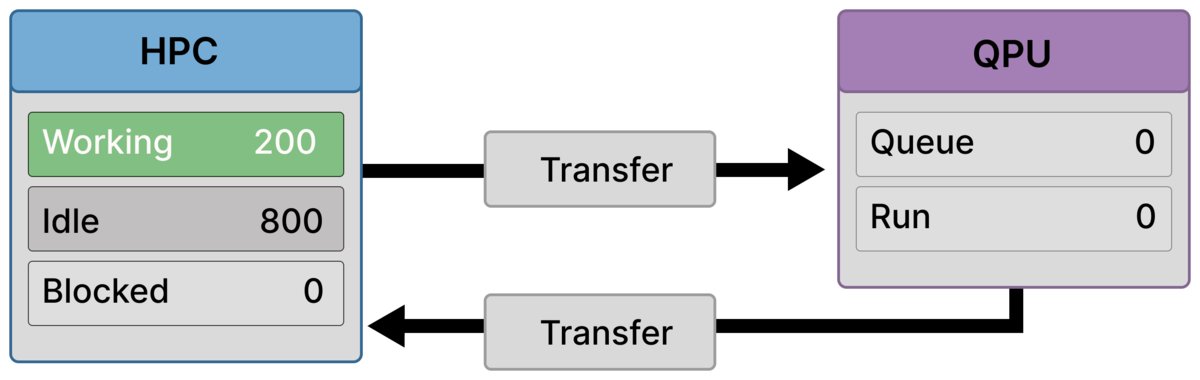
Only a subset of ranks (Working ≈ 200) is active, preparing quantum circuits.
The remaining ranks are Idle ≈ 800 because the preparation workload is small relative to the allocated HPC resources.
This idle state is intentional: these ranks are reserved for the upcoming globally synchronized optimization phase.
No quantum execution is active yet.
Frame 2 — Submission begins, first ranks block (199 working / 1 blocked)
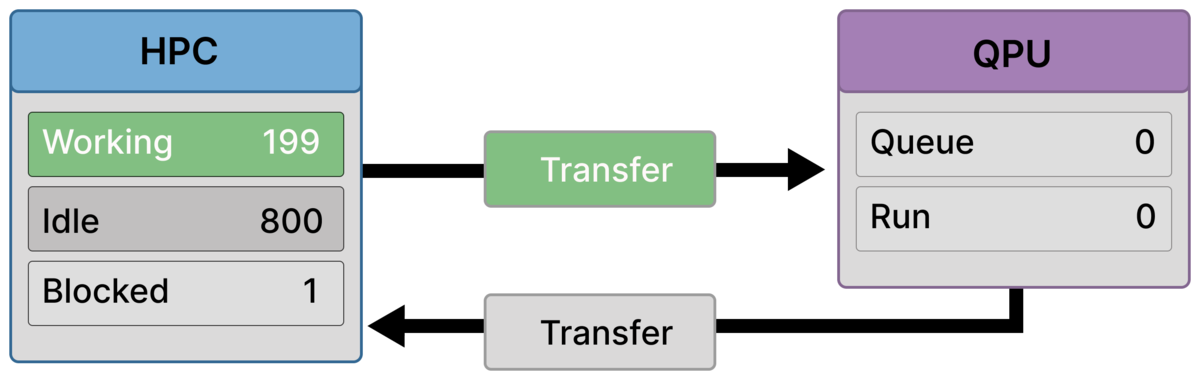
The first quantum submission occurs.
The submitting rank reaches a dependency on its quantum result and becomes Blocked.
Other preparation ranks continue working, while non-participating ranks remain idle.
This marks the start of dependency accumulation, but not yet a global barrier.
Frame 3 — Quantum phase active, partial barrier (200 blocked)
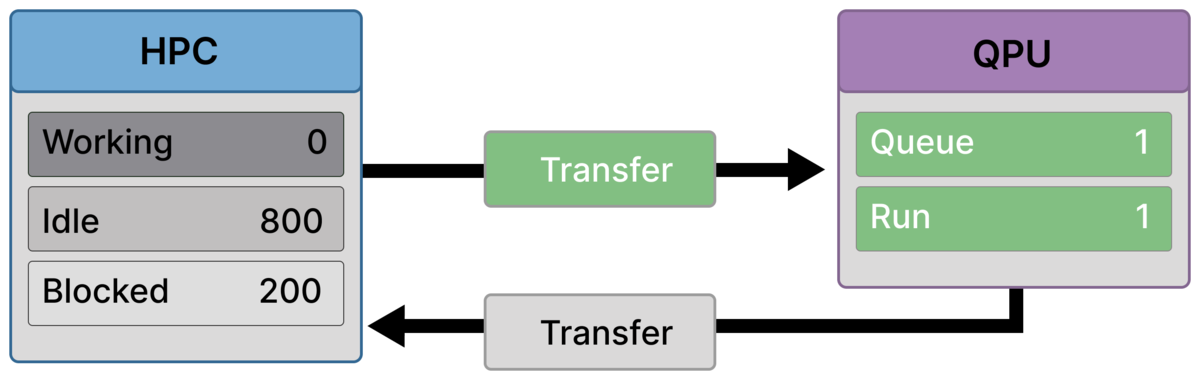
All circuit preparation is complete.
The ranks that participated in preparation (Blocked ≈ 200) are now waiting for quantum results.
At this point, classical progress is no longer possible: the next valid step requires the entire quantum result set.
Frame 4 — Global synchronization wall forms (1000 blocked)
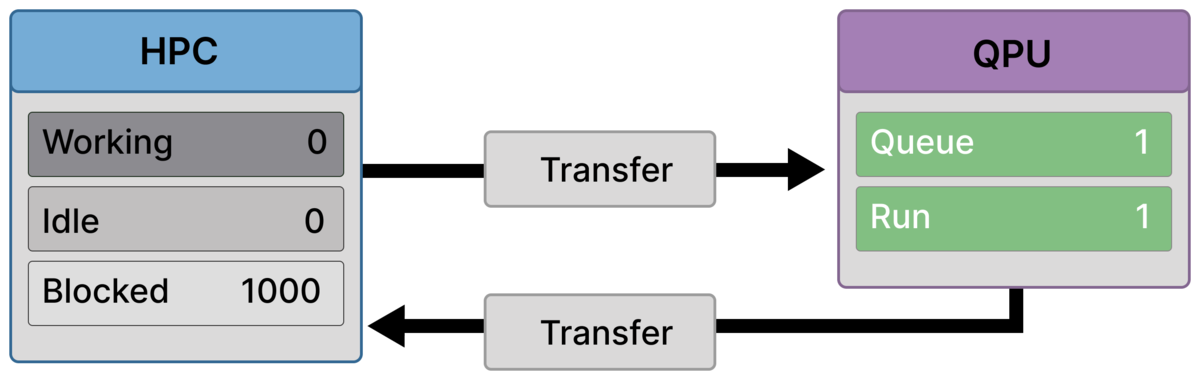
The workflow reaches the global aggregation point.
All ranks — including those that never submitted quantum jobs — now depend on the complete quantum result set.
As a result, all 1000 ranks are blocked at a global barrier.
Blocking propagates through algorithmic dependency, not through job submission.
Frame 5 — Last quantum result returns
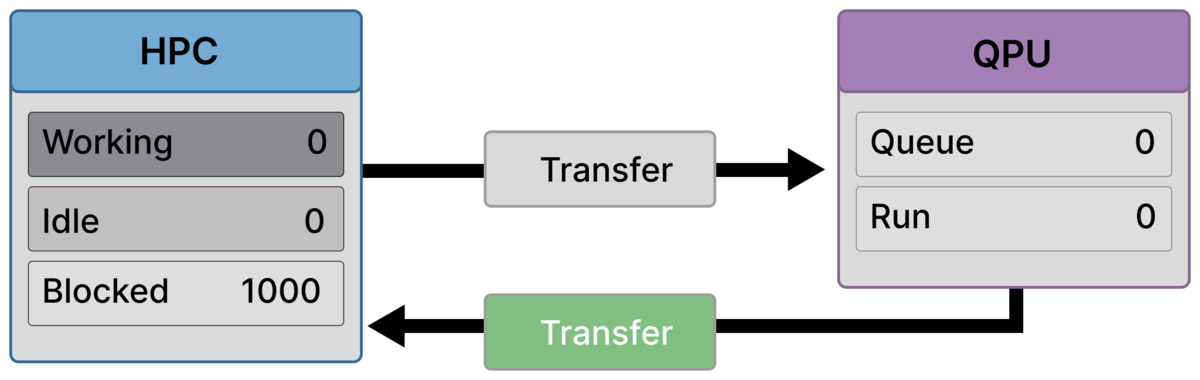
The final quantum result required for this iteration is transferred back.
This single event resolves the global dependency and releases the barrier.
Frame 6 — Collective recovery and optimization (1000 working)
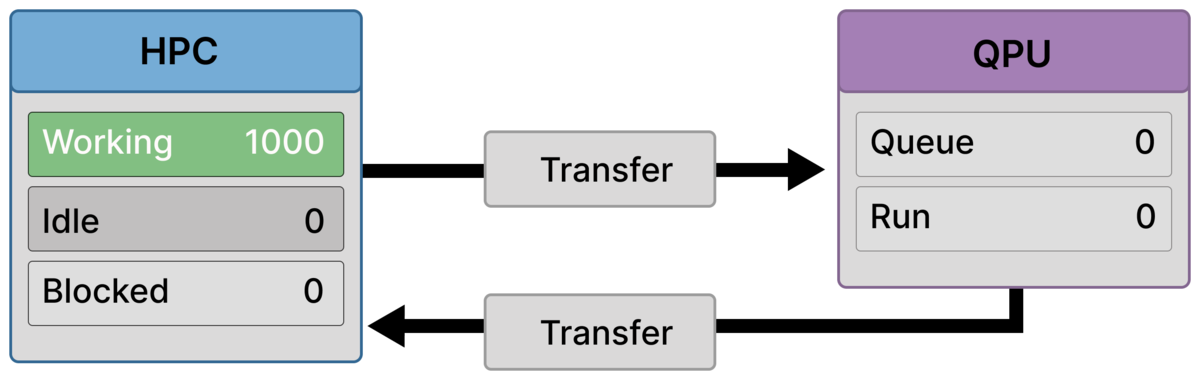
All ranks resume execution simultaneously.
The workflow enters the collective optimization and aggregation phase, utilizing the full HPC allocation.
The same synchronization pattern will repeat in the next iteration.
Why ranks are idle — and why this is intentional
Ranks are idle in this scenario by design, not due to inefficiency.
Once a workflow reaches a global quantum dependency, any classical work that would extend beyond that point risks violating correctness. Well-designed implementations therefore avoid speculative computation and instead accumulate ranks at a defined synchronization point.
In synchronized hybrid workflows, unused classical capacity is often the cost of maintaining a consistent global state.
Where this scenario appears
Scenario B is representative of:
VQE and QAOA workflows
Variational optimization loops
Algorithms requiring full expectation-value aggregation
Iterative quantum–classical feedback systems
It reflects common real-world hybrid execution patterns.
Takeaway
Scenario B demonstrates that parallel preparation does not imply independent progress.
In VQE-style workflows, circuit execution can scale, but learning is serialized by global aggregation requirements. The resulting synchronization wall stalls the entire system — not because hardware is unavailable, but because the algorithm forbids progress until agreement is reached.