Idealized Baseline (Loosely Coupled Workflow)
Scenario A illustrates a hybrid Quantum–HPC workflow in which quantum execution is present but non-disruptive. Classical computation dominates runtime, quantum calls are infrequent, and no structural bottleneck limits overall progress.
This scenario serves as a reference configuration: it shows how a hybrid system behaves when none of the common failure modes—synchronization, latency, or throughput limits—are active. Classical and quantum work are loosely coupled and overlap cleanly, without introducing dominant bottlenecks.
Purpose of This Scenario
Scenario A shows:
How a hybrid workflow looks when no single constraint dominates
What “good overlap” between HPC and QPU execution means conceptually
A baseline against which synchronization, latency, and throughput limits can be contrasted
The purpose is not realism, but clarity. Later scenarios intentionally violate one or more of the assumptions established here.
What characterizes this workflow
In this scenario, quantum execution is loosely coupled to classical execution:
Quantum jobs are triggered by individual ranks
Results are consumed locally
No rank depends on global quantum state to proceed
The QPU is never a shared coordination point
As a result, quantum execution does not appear on the critical path of the HPC workload.
Bottlenecks
There is no dominant bottleneck in this scenario.
No synchronization bottleneck
No global barrier forces ranks to wait for quantum results.No latency bottleneck
Data transfer and control overhead are negligible relative to classical computation.No throughput bottleneck
Quantum submission rate remains far below QPU service capacity.
This is the only scenario in which it is legitimate to say that nothing structural is slowing the system down.
Assumptions that matter
Scenario A relies on a narrow but explicit set of assumptions.
Algorithmic structure
Hybrid algorithm with long classical phases
Quantum calls are infrequent and optional
Each quantum result affects only the submitting rank
Timing regime
Classical work dominates overall runtime
Quantum execution time is short relative to classical work
Network transfer latency is negligible
HPC execution model
Many ranks execute classical work concurrently
A rank submitting a quantum job does not stall others
Submission temporarily blocks the submitting rank (it cannot continue classical work until its quantum result returns), but it does not block progress elsewhere.
Quantum execution model
Single-lane (serial) QPU execution
At most one quantum job is active or queued at any time
No admission control or throttling is required
Violating any one of these assumptions leads directly to Scenarios B–D.
Frame-by-Frame Walkthrough
Frame 1 — Classical steady state
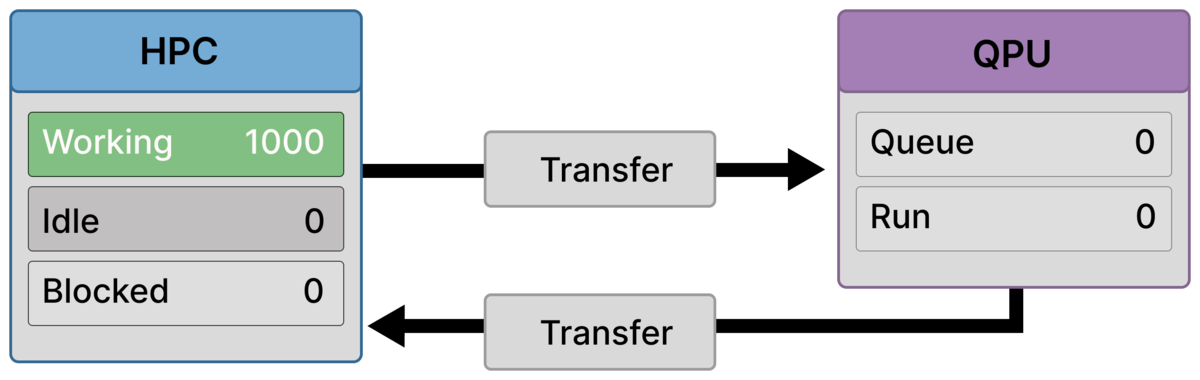
All HPC ranks are performing classical computation.
No quantum jobs are active. The QPU is idle.
This represents a long classical phase (e.g., preprocessing or local computation).
Frame 2 — Single submission
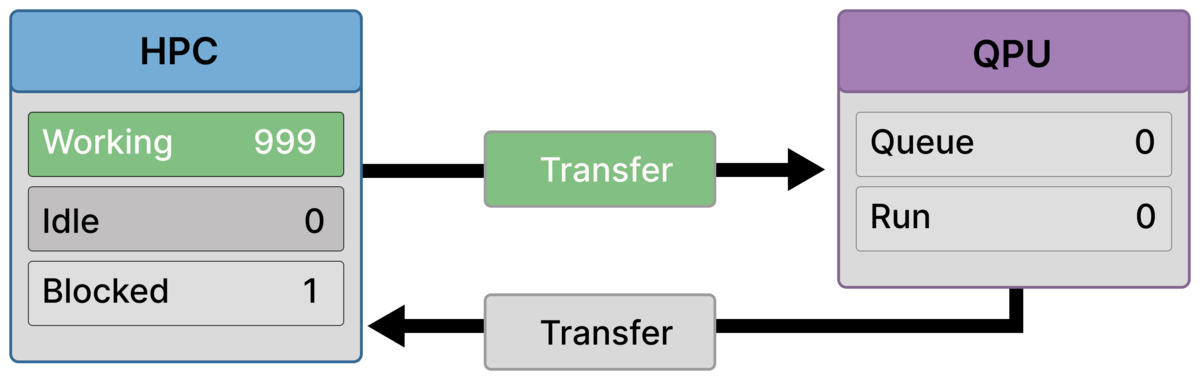
One rank finishes a classical step and submits a quantum job.
That rank becomes Blocked (waiting on its own quantum call) while the job is transferred and executed.
Crucially, no other rank is affected.
Frame 3 — Job arrives at QPU
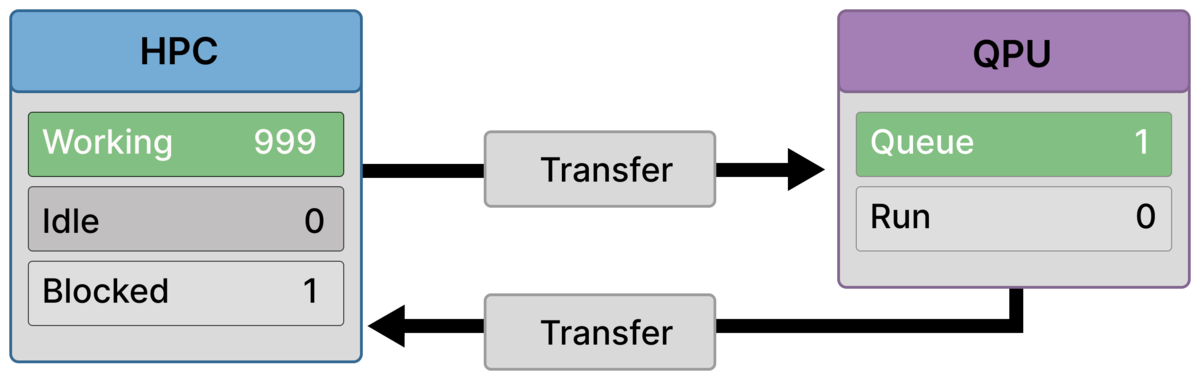
The quantum job arrives at the QPU and enters execution.
There is no queue buildup.
The HPC side continues uninterrupted.
Frame 4 — Quantum execution overlaps with classical work
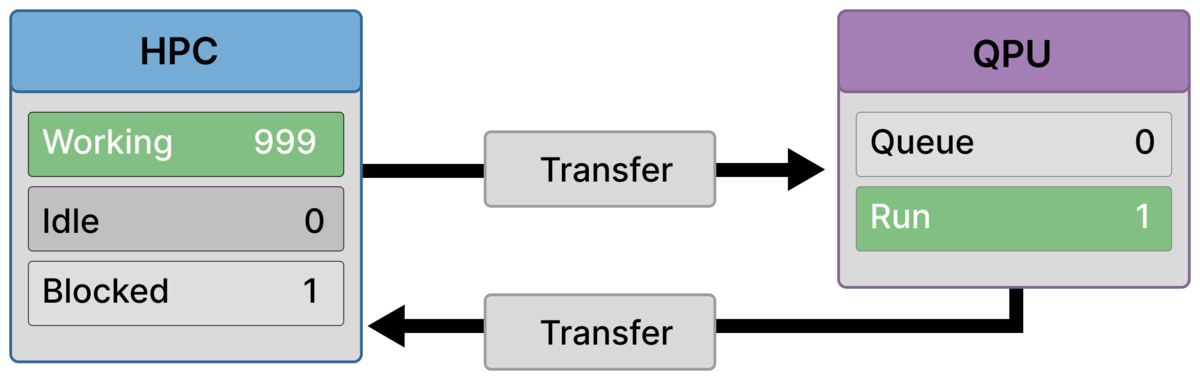
Quantum execution proceeds while nearly all HPC ranks remain Working.
This overlap is the defining feature of Scenario A: quantum execution does not reduce aggregate classical throughput.
Frame 5 — Result returns
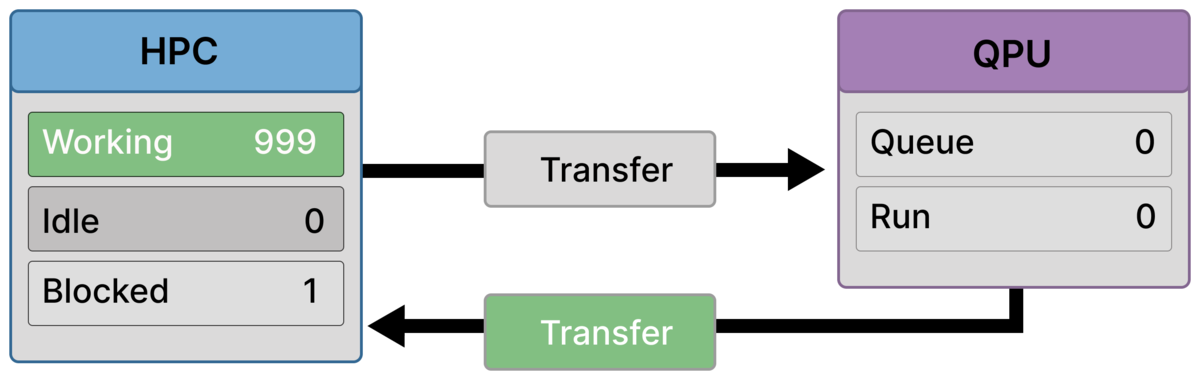
The quantum result is transferred back.
The result returns and unblocks the submitting rank, which resumes classical work immediately. The QPU becomes idle.
Frame 6 — Restored equilibrium
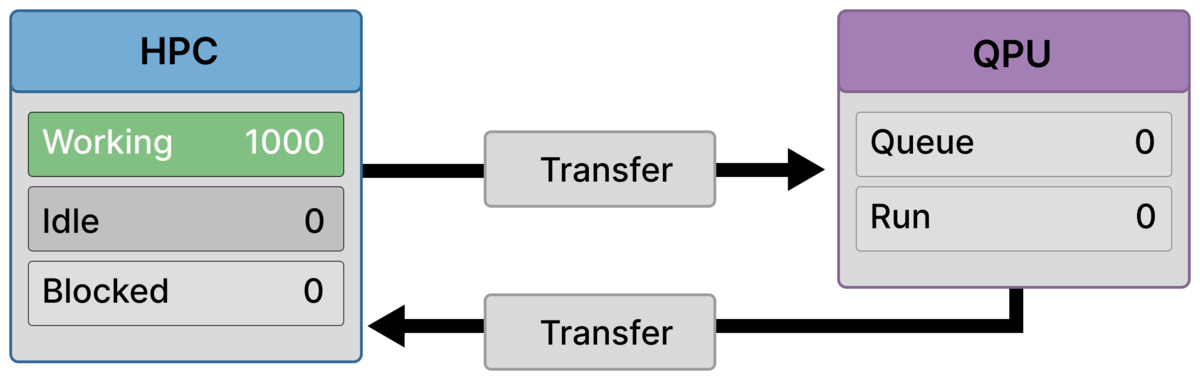
The system returns to its initial state:
All HPC ranks working
No idle or blocked ranks
QPU idle, awaiting the next infrequent submission
The workflow shows no visible memory of having invoked quantum execution.
Why This Scenario Matters
Scenario A establishes a baseline mental model:
What clean overlap looks like
What it means for quantum to be off the critical path
Which assumptions must hold for that to remain true
Every later scenario can be read as a controlled failure of one or more of these assumptions.
Where this scenario actually appears
Scenario A loosely corresponds to:
Toy or demonstration workflows
Exploratory hybrid experiments
One-off quantum calls embedded in large classical analyses
Educational examples designed to illustrate hybrid structure
It does not describe scalable production hybrid workloads.
Takeaway
Scenario A shows a hybrid Quantum–HPC workflow in which quantum execution is present but structurally irrelevant to system performance.
It is a reference point, not a goal — and its fragility is precisely why the other scenarios matter.